If Your Roof
Has Chalky, Faded Paint on Firm Panels
Rubbing a palm across the steel leaves white residue, and the panels flex only slightly underfoot.
Start WithClean, Prime, and Coat
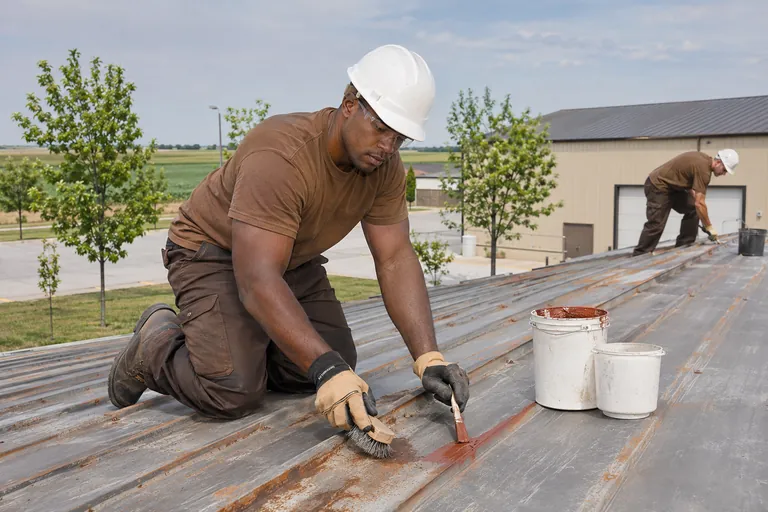
As a Papillion commercial metal roof coating contractor, we prime rust, seal every lap and screw, and coat steel roofs on warehouses, shops, and plants.
Papillion commercial metal roof coating works over steel that still holds together. These cards show the conditions we see and where each one leads.
Rubbing a palm across the steel leaves white residue, and the panels flex only slightly underfoot.
Orange bloom rings each screw head, yet the metal around it stays hard when probed.
Stains line up with panel joints inside, where lap sealant has dried and shrunk.
A screwdriver pushes through the steel at the eaves or beside old patches.
Steel roofs fail at the same few details. Here is what owners notice, what causes it, and what the coating job does about it.
Daily heating and cooling push panels back and forth, and each winter loosens the threads a little more.
Loose screws are driven tight, stripped holes get oversized fasteners, and each head is capped with base coat.
End laps sit flat where water slows down, and old sealant there pulls away first.
We clean each end lap, bed polyester fabric in base coat across it, and topcoat the detail before the field coats.
Snow sits at the low edge of the roof, and meltwater keeps the paint wet for weeks.
Scale is wire-brushed or ground off, a rust-inhibiting primer goes on, and rusted-through panel ends are replaced.
Penetrations were caulked when the roof went on, and that caulk has cracked with years of vibration.
Old caulk comes off, the flashing is rebuilt with fabric and base coat, and the coating ties it into the panels.
A metal roof coating job is built from a few choices. This spec sheet shows the options we pick between on steel roofs here.
| Option | Best On | Prep It Needs | Recoat Later With |
|---|---|---|---|
| Acrylic over primer | Pitched panels that drain fast | Wash, rust primer, lap fabric | Acrylic |
| Silicone over primer | Low-slope steel with ponding | Wash, primer, lap fabric | Silicone only |
| Rust-inhibiting primer coat | Any steel with surface rust | Wire brush or grind to firm metal | The topcoat system |
| Fastener caps only | Firm roofs leaking at screws | Tighten or swap screws | Field coat later |
| Panel swap plus coating | Roofs with a few rusted-through panels | New steel matched to the profile | The topcoat system |
A coated steel roof changes in ways you can see from the deck. These are the changes we look for when the work is done.
Call and describe where the water shows up. Screw lines and laps are the most common sources on steel roofs, and we check both first.
(531) 985-9881
The order matters on steel. Each step here finishes before the next one starts, so the coating bonds to clean, primed, sealed metal.
Every screw line, lap, curb, and eave gets checked on foot. We probe rust with a screwdriver and test for wet insulation wherever stains show inside.
Loose screws are driven home and stripped ones are swapped for oversized fasteners with new washers, so no screw is left moving under the film.
Flaking rust is wire-brushed or ground to bright metal, the roof is power washed, and a rust-inhibiting primer goes on each treated area.
Polyester fabric bedded in base coat covers side laps, end laps, ridge caps, curbs, and pipe boots before any field coating starts.
Base and finish coats run panel by panel at the specified thickness. A wet film gauge confirms the build, and we walk the roof after cure.
Some steel roofs need a different system, or a second one on part of the building. These are the ones we pair most often.
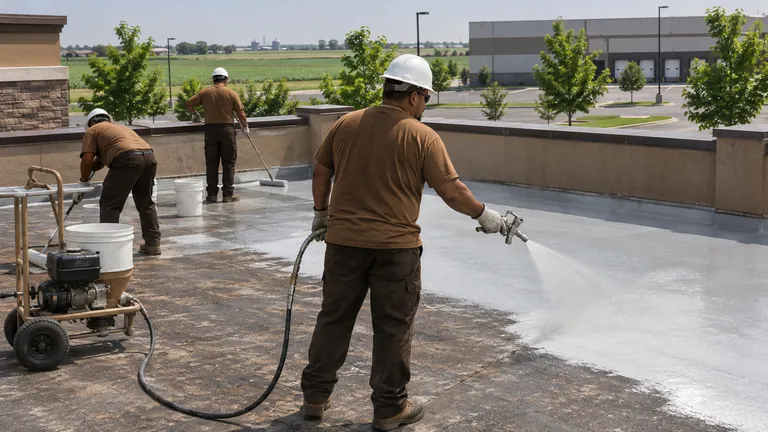
Low sections of a steel roof that hold water after storms take silicone over primer, while the pitched sections around them keep a metal coating.
See Silicone Roof Coating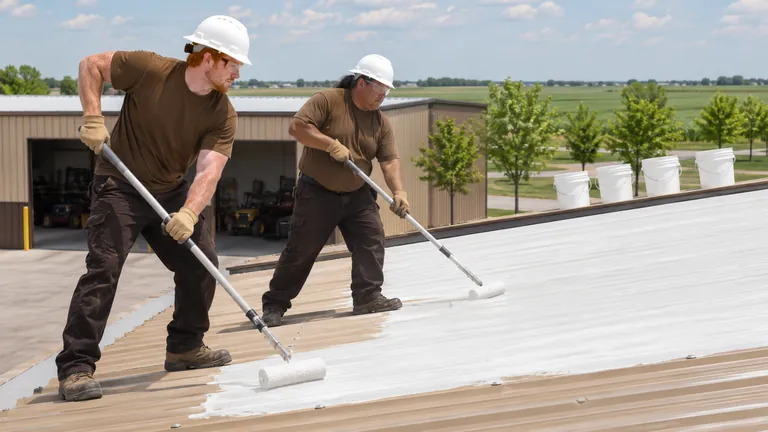
Pitched panels that shed rain within minutes often get acrylic as the field coat, with fabric and base coat at every lap.
See Acrylic Roof Coating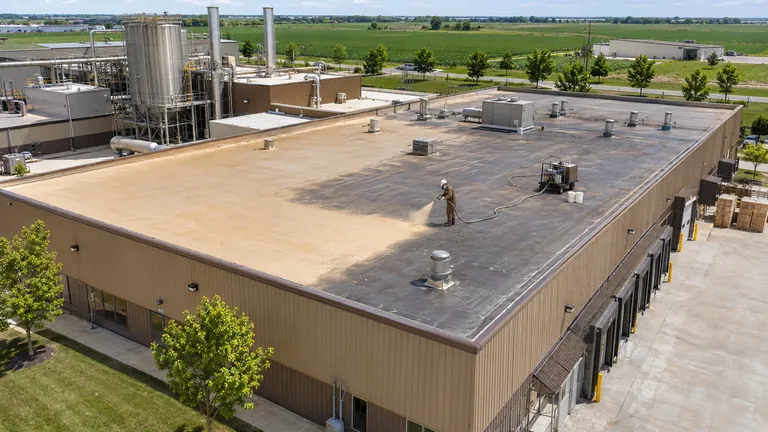
Uninsulated shops where heat pours through the panels can take closed-cell foam first, then a topcoat that shields it from sunlight.
See Spray Foam Roofing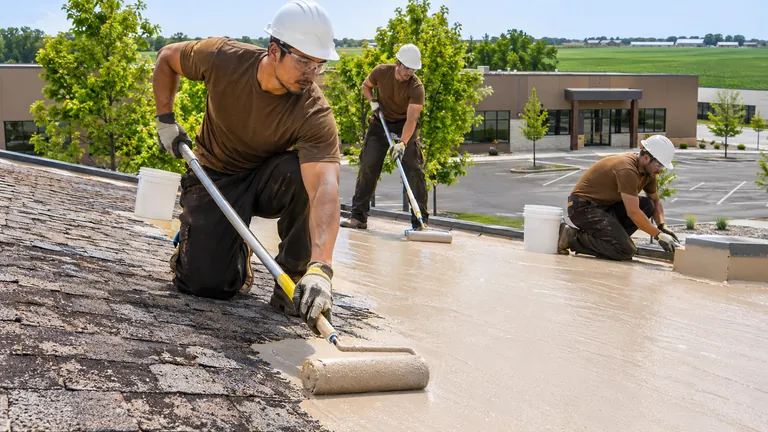
Office wings with asphalt shingles beside a steel warehouse get their own shingle coating, applied after loose tabs are fixed.
See Shingle Roof CoatingAnswers to what owners of steel buildings ask us most about the coating work itself.
Plan on about $2.50 to $4.00 per square foot for coating, with replacement at about $5 to $8. Heavy rust, screw swaps, lap fabric, and extra coats push a job higher in the range, and big open roofs with easy lift access keep it lower. Wet insulation can move the job toward replacement.
Yes, once every screw is dealt with. We tighten the loose ones, swap stripped ones for oversized fasteners, and cap each head. Side laps and end laps get fabric in base coat. Coating straight over loose screws would leave the same leaks under the film.
We wire-brush or grind flaking rust down to firm steel, power wash the roof to remove chalk and oil, and prime every treated spot with a rust inhibitor. Panels rusted through are cut out and replaced with matching steel before any coating starts.
First. Laps, ridge caps, curbs, and penetrations are where water enters a steel roof, so each one is cleaned, coated, bedded with polyester fabric, and topcoated before the field coats. The field coats then tie all of that detail work into one membrane.
Papillion’s Building and Fire Safety Department makes that call. The city has adopted the 2018 International Building Code and 2018 International Existing Building Code, and its permit forms cover re-roof work. We check with the department before any coating starts.
Slope, ponding, and rust decide it. Silicone handles standing water on low sections, acrylic fits pitched panels that drain fast, and rusted steel needs a rust-inhibiting primer under either one. We pick after seeing the panel profile and drainage on your roof.
Hail can dent the steel and, in heavier storms, split the coating where stones hit laps and screw heads. Dented panels with an intact film keep water out. After a storm we walk the roof, then clean and recoat damaged spots and replace cut fabric.
Send the roof size and condition for a ballpark range, then we walk the steel and confirm the prep it needs.